
 Posts


 "The eldest of the fishermen, Memo, rubs his grizzled chin in somber recollection, for one of our students has just asked a pointed and painful question: Which species have disappeared in his lifetime?
As he nears the end of his list, it’s hard not to imagine what might have been: a wildly plentiful eco-system, yielding its riches year after year; and these very men, supporting themselves and their families with relative ease. But instead, they work harder each year, driving their fishing boats ever farther, pursuing a meager haul of reef fish."
Showing posts with label Animals. Show all posts
Showing posts with label Animals. Show all posts
4.2.09
A Must Read: Fish Shares and Sharing Fish

12.11.08
A Must Read: Supreme Court Rules Against Whales in Navy Case

From the AP summary:
The court did not deal with the merits of the claims put forward by the environmental groups. It said, rather, that federal courts abused their discretion by ordering the Navy to limit sonar use in some cases and to turn it off altogether in others.
The overall public interest tips "strongly in favor of the Navy," Roberts wrote. He said the most serious possible injury would be harm to an unknown number of the marine mammals.
"In contrast, forcing the Navy to deploy an inadequately trained anti-submarine force jeopardizes the safety of the fleet," the chief justice wrote.Read the full article by clicking HERE
29.10.08
Congo Gorillas Caught in Renewed Rebel Violence

After four gorillas were killed by illegal charcoal traders to send a message to local wildlife officials, National Geographic sent a film team to document the unfolding situation.
What they found was a community of 200 extremely endangered mountain gorillas whose home had become ground zero for a war between rebels, charcoal traders and the rangers charged with protecting these gorillas.
Unfortunately, the political environment in Virunga has not changed and violence is still threatening the lives of mountain gorillas caught in the crosshairs of human conflict.
Just this past Monday (Oct. 26, 2008) rebels sized and vandalized the headquarters of the Virunga National Park rangers. Over 50 park rangers fled their headquarters because of rebel violence, leaving the gorillas without protection.
Increasing violence by these same rebels, loyal to renegade general Laurent Nkunda, has now brought 17,000 United Nations forces to the area to protect villagers. A rebels encampment is located in the center of the Mikeno section of Virunga that is home to the gorilla community. The 17,000 UN soldiers, with their tanks and helicopters, are awaiting orders to invade the rebel encampment. This type of activity would certainly disrupt the lives of the gorillas and would severely threaten their survival.
Unfortunately, taking the rebels out may be the only path to protecting what's left of the mountain gorillas. Reports of rebels killing and eating gorillas, as well as charcoal trader symbolic murders, paint a very threatening environment.
The United Nations successfully mediated a meeting between rebels and wildlife groups to create a pledge to stop the gorilla killings. That pledge, however, was short-lived and gorilla killings continued at the end of 2007 through today.
If you'd like to do something to help the situation in Congo, you can visit Gorilla.Wildlifedirect.Org.
If you would like to read more about the situation in Virunga, you can read the daily blog of the park's director HERE.
25.10.08
Defenders of Wildlife Post New Palin Ad

Many view hunting wolves during the winter when they cannot hide to defend themselves and from helicopters when hunters cannot strategically hit the animals in less painful, more paralizing points, as cruel and unsportsmanlike.
The group's newest ad addresses Palin's views on polar bears. Recently, the United States government deemed polar bears a threatened species because of threats to their sea ice habitat from increased global temperatures. Palin sued the Bush administration to block this distinction because oil and gas companies could face limitations in their drilling and refining capacities in the Alaska region as a result. In addition, Palin has allowed polar bears to be hunted for body parts and trophies, according to the ad.
FactCheck.org has reviewed the first Defenders of Wildlife ad and called it "factually correct, though incomplete." According to FactCheck, the issue of whether aerial hunting is ethical is for individuals to decide, but they say that decreasing wolf populations in Alaska was largely permitted for maintenance of moose and caribous populations for "subsistance hunting." Palin did support a 2007 Alaska law that would have expanded aerial hunting to include wolverines, brown bears and wolves. The law also would have reduced requirements to qualify for aerial hunting in certain areas. However, the existing Alaska law has a complex regulatory structre for hunting permits and wildlife population maintenance. FactCheck points out that the issue of aerial hunting is devisive in Alaska.
To read the Defenders of Wildlife's views on Palin's hunting policies, go HERE.
To read FactCheck.org's review of the ad, go HERE.
Below is the polar bear ad recently created by Defenders of Wildlife. It is being aired in several states.
17.10.08
Palin Fails to Stop Whale Protections

Today, the NOAA determined that the beluga whale is not recovering fast enough from initial protections and must be labeled "endangered" to ensure survival of the species.
The population of these beluga whales decreased 50% between 1994 and 1998. Currently their numbers stand at approximately 375 whales.
When the proposal to list the species as endangered was initially submitted, Governor Sarah Palin's administration openly questioned the science supporting increased protections. It is no coincidence that the Interior Department has proposed opening the Cook Inlet where these whales live to oil leases. This is just another example of Palin attempting to block protections for the environment for the benefit of oil and gas industries. She has previously sued the government to block listing of polar bears as threatened species for the same reasons.
To read a full story on the beluga whale situation, click HERE.
9.10.08
A Must Read: Supreme Court & Whales

From the Chronicle...
"Environmentalists warn that the mid-frequency sonar used by the Navy can harm or kill whales by forcing the mammals to dive deep to avoid the sound, causing decompression sickness. The electronic devices also interfere with the mammals' ability to navigate underwater and prompt them to change their breeding habits.
The Bush administration, which appealed a lower court order against the Navy, argues that the sonar is essential to military training exercises designed to help sailors learn how to detect enemy submarines."Read the full story HERE.
25.9.08
Your Pet's Carbon Pawprint
 Slate.com's "Green Lantern" is back again with some insight into the problem of raising an environmentally friendly pet. He focuses specifically on the problem of the animal's waste.
DOGS -
The Green Lantern says that while we're all trained to clean-up our pet's waste on the sidewalk or in public areas, it is just as important to clean it up in our own yards. Why? Because your pet's waste contains harmful bacteria that can end up in rivers and streams when it rains. The waste also contains high levels of nutrients, which in excess can suffocate local water bodies with non-native plants and can create bacterial blooms.
According to the Green Lantern, the best ways to dispose of your pet's waste include dumping it into the toilet where it will be properly treated by your municipal water treatment facility, burying it 12 inches deep in the yard away from vegetable gardens or composting it by following THESE instructions. Always try to reuse grocery bags to pick up your pet's waste, or even better, use biodegradable bags.
CATS -
Cat waste is more complicated than dog waste (go figure). Some household cat's contract an undetectable parasite called Toxoplasma Gondii and can shed the parasite's oocysts in their waste. This oocyst is toxic to both humans and wildlife. Even sewage treatment plants are ineffective in killing the oocyst. If your cat spends time outdoors, keep an eye out for their waste and pick it up to protect your neighboring humans and animals.
The best way to manage the cat's waste, whether it is outside or inside, is to use kitty litter; just make sure you pick the right kind. Stay away from litter that is made from bentonite clay or fuller's earth. These products are extracted from the ground by stripping away the earth's surface, destroying plants, animals and habitats in the process. Instead, look for litter made of recycled newspaper, wheat, corn cobs or reclaimed sawdust. These litters can be composted and used in the garden. If you use litter box liners, choose biodegradable ones.
To read the full Green Lanter column on your pet's carbon pawprint, click HERE.
23.9.08
Polar Bears Eat Eachother to Survive

Obviously human beings cannot survive in the Arctic, but the inhabitants of the sea ice ecosystem are suffering terribly from the increased melt rate. "The Arctic sea ice melt is a disaster for the polar bears," according to Kassie Siegel, staff attorney for the Center for Biological Diversity. "They are dependent on the Arctic sea ice for all of their essential behaviors, and as the ice melts and global warming transforms the Arctic, polar bears are starving, drowning, even resorting to cannibalism because they don't have access to their usual food sources."
This extreme behavior by the polar bears is an indication to humans that the conditions in the Arctic are reaching their breaking point. As sea ice melts, it can no longer reflect the sun's radiation. Instead, the darker ocean waters absorb the heat from the sun, causing global temperatures to increase. These changes will result in unusual weather patterns, adjustments in the jet stream and more.
Back in May, the U.S. Department of the Interior took steps to protect polar bears and their habitat by listing them as threatened under the Endangered Species Act. What actual protection this listing can provide against global climate change is unknown. Its important to remember that Gov. Sarah Palin opposed the listing of the polar bears because she felt the listing would interfere with the oil and gas industry's operations in Alaska. She also believes global warming is a myth.
Humane Society Breaks Tradition, Endorses Obama

Yesterday, the Fund's Board of Directors, which is made up of Democrats and Republicans, voted unanimously to endorse Senator Barack Obama.
In their endorsement, the Fund's Board explained their reasons for endorsing Obama..."Senator Barack Obama has been a solid supporter of animal protection at both the state and federal levels. As an Illinois state senator, he backed at least a dozen animal protection laws, including those to strengthen the penalties for animal cruelty, to help animal shelters, to promote spaying and neutering, and to ban the slaughter of horses for human consumption. In the U.S. Senate, he has consistently co-sponsored multiple bills to combat animal fighting and horse slaughter, and has supported efforts to increase funding for adequate enforcement of the Animal Welfare Act, Humane Methods of Slaughter Act, and federal laws to combat animal fighting and puppy mills."
The Fund listed some of the animal protection bills that Senator John McCain has also co-sponsored but said that he has been largely absent on many important animal issues in the Senate. Far and away, the biggest reason the Fund failed to endorse Senator McCain was his selection of Gov. Sarah Palin for his running mate, whom they say has done more harm to animals than any other current governor in the United States.
The Fund listed some of the animal protection bills that Senator John McCain has also co-sponsored but said that he has been largely absent on many important animal issues in the Senate. Far and away, the biggest reason the Fund failed to endorse Senator McCain was his selection of Gov. Sarah Palin for his running mate, whom they say has done more harm to animals than any other current governor in the United States.
The Fund explained their discomfort with Palin this way, "Palin engineered a campaign of shooting predators from airplanes and helicopters, in order to artificially boost the populations of moose and caribou for trophy hunters. She offered a $150 bounty for the left foreleg of each dead wolf as an economic incentive for pilots and aerial gunners to kill more of the animals, even though Alaska voters had twice approved a ban on the practice. This year, the issue was up again for a vote of the people, and Palin led the fight against it—in fact, she helped to spend $400,000 of public funds to defeat the initiative."
To read the Humane Society Legislative Fund's full endorsement statement, click HERE.
To read the Humane Society Legislative Fund's full endorsement statement, click HERE.
Here is a video from the Defenders of Wildlife explaining Gov. Palin's support for aerial hunting...
3.9.08
Palin Fought Polar Bear Protections for Oil Companies

ABC News is reporting that Gov. Palin sued the Bush Administration this year to stop the listing of polar bears as threatened under the Endangered Species Act. She believed the government was too accepting of climate change science and its impact on the bears. She also feared that increasing protection for polar bears would negatively affect the oil and gas industries in Alaska.
The exact language from the Palin Administration lawsuit against the federal government stated..."Listing the polar bear as a threatened species [under the Endangered Species Act] will have a significant adverse impact on Alaska because. . . [it] will deter activities such as commercial fisheries, oil and gas exploration and development, transportation, and tourism"
The decision by the government to protect polar bears was largely based on the findings of the U.S. Geological Survey. In the Alaska lawsuit, these studies were questioned, despite the fact that Alaska's own state scientists stated that the Geological Survey's research was reliable.
The science provided by the U.S. Geological Survey, an independent government agency, may not have been sufficient enough for Gov. Palin, but research paid for by Exxon-Mobile was. According to the ABC News article, Palin supported the conclusions of research funded by the American Petroleum Industry and Exxon, which of course did not advocate protecting polar bears from the effects of global warming.
To read the full ABC News piece, click HERE.
EPA Protecting Bee Killers?

In the last two years, bee populations have dropped more than 30%. The result of this loss is a collapse of bee colonies in several states. Bees provide economic benefits called "ecoystem syervices" to U.S. crops. It would cost $15 billion to human engineer the pollination benefits bees provide to farmers.
Scientists are trying to figure out what is causing the bees to disappear. One leading theory is that pesticides used on crops the bees pollinate are poisoning them. In particular, scientists are concerned about a new class of pesticides being spread on crops.
This is where the EPA comes in. Bayer CropScience, a pesticide manufacturer recieved EPA approval five years ago for a new pesticide. Scientists would like access to the research information used by the EPA in their approval process to see if the pesiticde is to blame for bee population decreases. Unfortunately, the EPA is refusing to make public their information.
The Natural Resources Defense Council has filed a lawsuit to gain access to the information being withheld by the government ageny. The NRDC believes the EPA is putting corporate interests above their stated mission of protecting species.
To read the NRDC release on their EPA lawsuit, click HERE.
2.9.08
Fireflies Disappearing
 As a native Floridian, it was very exciting to move to the mid-Atlantic region of the country and see fireflies during the summer. We don't have fireflies in Florida, so I was like a kid searching the night air for those flickers of light.
Because I love fireflies so much, I was dismayed to read that their numbers are dwindling. The first signs of a drop in firefly populations appeared in Thailand where there has been a 70% decrease in fireflies in just three years. Scientists from around the world descended on Thailand to discuss the possible explanation for this population decrease and debate whether it serves as a warning to humans.
Researchers are constantly aware of the "canary in a cold mine" role that plants and animals play. Other species are more sensitive to changes in temperature, oxygen levels and the presence of toxins. If a species shows unusual behavior, it may be a sign to humans that changes in our environment could begin negatively affecting us as well. These species are called "indicator species."
So far, scientists have not concluded whether fireflies are indicator species or not. This is because scientists haven't isolated the cause of the population decrease. Some anecdotal evidence points to the growing presence of artificial light. Artificial lights impede the mating process for fireflies because their light cannot glow bright enough to attract a mate. Other theories focus on the growth of urban sprawl and the resulting increases in air pollution.
Fireflies are unusual insects. There are 2,000 different species of them, with many new species discovered all the time. Most of the species have never truly been studied. There are still many questions unanswered about their light and its purpose. They are very difficult to count or track and have short lifespans of about 3 weeks. Regardless, they are still members of an ecosystem and their behavior tells a story about the condition of that ecosystem.
If you want to help protect firefly populations, there are two things you can do. First, you can turn your outdoor lights off or as low as possible. Second, you can post sightings of fireflies on THIS website to help scientists track their numbers.
If you'd like to read more about the firefly population decrease, click HERE.
14.8.08
Ocean's Dead Zones Doubling
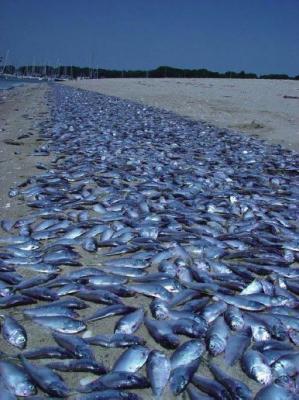
Dead zones are created when nutrients from fertilizers and waste end up in the ocean when rain washes them into rivers and streams that lead to the sea. These nutrients offset the natural balance in the ocean, creating the perfect environment for algae to bloom in huge numbers. Eventually this algae dies and sinks to the sea floor where it decays and destroys all of the oxygen, suffocating the plants and animals living in the area and creating an uninhabitable wasteland.
Robert Diaz, a professor at the Virginia Institute of Marine Science, recently led a study to count the number of dead zones on earth and his findings were very troubling. The number of dead zones has doubled every year since 1960. Diaz and his staff counted more than 400 currently existing dead zones around the world. These zones range from the massive ones in the Gulf of Mexico and Baltic Sea to smaller ones that appear in rivers and estuaries.
In the Chesapeake Bay alone, the amount of uninhabitable space caused by these dead zone conditions would have enough sea life to feed half of the commercial crab harvest for a year.
In an interview with the Washington Post, Robert Diaz said, "We're saying that hypoxia is now everywhere, it seems," said Diaz. "We can say that human activities really screwed up oxygen conditions in our coastal areas."
It is possible to recover these dead zones. Currently 4% of the total dead zones have shown some signs of recovery. Specifically, Florida's Indian River and New York's Hudson River have seen great improvement. Recovery requires significant changes in the use of fertilizers, the management of water run-off and improved water management.
As a consumer, oceanic dead zones are a great argument in favor of purchasing organic groceries that are not dependent on fertilizers and pesticides that contribute to these problems. As a voter, this is an issue your representatives should be made aware of.
To read the full Washington Post article on dead zones, click HERE.
12.8.08
Bush Looking to Weaken Endangered Species Act

For years, ultra conservative Republicans have tried to undermine the Endangered Species Act (ESA). These Republicans have such an expansive view of the free market that they believe only species able to compete with human development should survive. Their best chance at weakening the ESA is by greatly reducing the scientific review process that evaluates the impact of a proposed development on an endangered or threatened species, like the blue whale, and its habitat.
For years, mainstream Republicans and Democrats have successfully blocked many attempts by ultra conservative Republicans to change the scientific review process. Unfortunately, anti-ESA forces have found a friend in the White House and a way to completely avoid Congressional authority.
Newly drafted regulations proposed within the Executive Branch would make two significant changes to the ESA and would not require Congressional authorization.
The first change would remove the current independent review process that has been completed by objective government scientists for 35 years. Under existing law, a project built, funded or authorized by a federal agency must be submitted to either the Fish & Wildlife Service or the National Marine Fisheries Service where scientists independently evaluate the project for any impacts on endangered or threatened species. If the proposed changes to the ESA take place, there will no longer be this independent review and the agency overseeing the project will make its own determination of risk to species. Even if that agency has no scientific expertise or experience with endangered species, they can decide if a project is acceptable.
The second change to the ESA being proposed is a complete ban on considering a proposed project's contributions to global climate change. Many agencies have sought out the authority to consider greenhouse gas emissions and their impact on the climate or species when reviewing a project. Ultra conservative Republicans and President Bush want to make sure this type of consideration is illegal under the ESA.
If the proposed changes are approved, they would be the most significant changes to the Endangered Species Act since 1988. Already, President Bush has been criticized for using bureaucratic obstacles and red tape to make it harder to list a species as endangered or threatened. His new proposed regulations would essentially end the power of the ESA. A federal government handbook from 1998 described the independent scientific consultations as "some of the most valuable and powerful tools to conserve listed species."
Once the proposed changes are officially filed, a 60-day comment period would be initiated and supporters or opponents of the changes could voice their opinions. After that, the regulation would be approved prior to the November election. A new President would have the authority to reverse or freeze the changes, but that could take months. Congress could pass legislation blocking the changes, but that would take even longer.
To read more about the proposed changes, click HERE.
5.8.08
125,000 Western Lowland Gorillas Discovered
 During the 1980's a census was conducted to count the number of Western lowland gorillas still living on Earth. At that time, scientists estimated about 100,000 of these gorillas existed. Since the census, it is believed that the number of gorillas had dwindled to 50,000.
Fortunately, a recent survey conducted in the Lac Tele Community Reserve in northern Congo uncovered a huge number of unaccounted for gorilla. Hunters in the area told researchers that they had spotted large clusters of gorillas living in the swamp forests on the outskirts of Lac Tele.
A researcher with the Primatological Society Congress in Scotland reported that this new community of gorillas is the highest-known density of the animals that has ever been discovered. Based on the number of gorilla nests spotted in the area, the researchers estimate that 125,000 Western lowland gorillas live in the swamp.
In spite of this good news, many scientists believe the gorillas will still be viewed as endangered because the threats to their survival are so severe. The ebola virus is wiping out gorillas populations throughout Africa. In addition, commercial logging and bushmeat hunting have destroyed critical gorillas habitat.
Of the four gorillas subspecies, the Western lowland gorilla is the most numerous. Cross River gorillas, found in Cameroon and Nigeria, have suffered from illegal hunting and habitat loss that has left only 250-300 of these gorillas in existence. At one point in the 1970's the mountain gorilla had a population of 23 but has seen increases over the past three decades that has raised its population to around 700. Finally, the Grauer's gorilla of the Democratic Republic of Congo is believed to have a population of about 16,000.
To read more about the discover of Western lowland gorillas, click HERE.
27.6.08
Gorilla Murders: A Must See

You are probably now familiar with the infamous photographs of seven endangered mountain gorillas laying dead in a row in the Virunga National Park of the Democratic Republic of the Congo. Those images outraged the world, but the story behind them is as stirring as anything you'd read in a novel and National Geographic tells it perfectly in this film.
Virunga National Park is ground zero for a dangerous clash between human interests and the natural world. Right now the mountain gorillas and their habitat are the victims of this clash. Only 720 mountain gorillas exist in the world. The area where those photographs were taken, the Mikeno sector, is home to around 200 of these animals and is the subject of the film.
The death of the gorillas was not for meat or for trophies, it was a symbolic killing meant to scare off the rangers who have pledged their lives to protect these important creatures. Living just outside Virunga are over a million refugees of the Rwandan conflict. The refugees live in terrible conditions and rely solely on charcoal for energy to cook and survive. Virunga is home to forests full of old growth trees that are ideal for charcoal making. Illegally collecting these trees for charcoal and selling the fuel is a very profitable business. The people who trade in illegal charcoal will stop at nothing to protect their access to the Virunga forests that are also the sensitive habitat of the mountain gorillas.
The needs of the locals, the commitment of the rangers and the greed of the charcoal makers are at odds in the national park. This dangerous dynamic has lead to the corruption of top government officials who are responsible for protecting Virunga. It may even have been one of these officials who ordered those gorillas killed.
Complicating this environment is a group of Tutsi rebels who have managed to drive the rangers out of the Mikeno sector and are now the only people with access to the 200 mountain gorillas living there. The rebels' leader, Laurent Nkunda, is a dangerous criminal known for using child soldiers and systematic rape as tools of war. He promises that he is a conservationist interested in protecting the mountain gorillas. However, stories of his soldiers killing the gorillas for food have already spread throughout the area.
Watch this film and see the fascinating story in stunning photographs, compelling interviews and interesting facts. The access National Geographic gained to both the ongoing investigation and the parties involved is amazing. If you were affected by those awful pictures of these murdered mountain gorillas, you have to hear the story behind the crime.
The movie premiers on the National Geographic Channel on Tuesday, July 1st at 10:00pm. Don't miss it.
If you want to help the mountain gorillas, go to
5.6.08
A Must Read: Bureaucracy Hurting Whales
From CNN: "Collisions with ships are the number one cause of mortality, and entanglement in fishing gear is the number two cause," Lecky said. Because this animal is an endangered marine mammal, NMFS, a division of the National Oceanic and Atmospheric Administration, is charged with designing a recovery plan for them. More than four years of NOAA research showed that speed kills whales. Above a speed of about 10 knots, a right whale's encounter with a large ship would likely be fatal. NOAA is in charge of the scientific aspects of these types of rules, the federal Office of Management and Budget must weigh in on their economic impact. The OMB was supposed to make a decision on the rule last year -- but there is still no indication when it might act on it. Read the full story HERE

2.6.08
Sea Lions vs. Salmon: Kill One to Save the Other?

For years, conservationists and fishermen have suspected that the sudden disappearance of large numbers of Chinook salmon was attributable to sea lions traveling up the Columbia River to find and eat the endangered species. At one point, it was suggested that the sea lions be killed or relocated to avoid further destruction of the Chinook population. This idea never took hold, but now it looks like some are taking matters into their own hands as several sea lions have turned up dead in recent months.
To read the full article, go HERE.
31.5.08
A Must Read: Endangered Species as Political Pieces

"Enlisting endangered species in the fight against global warming is either a brilliant tactical maneuver - or an arrogant abuse of law."
Read more HERE
13.5.08
Save the Polar Bear

Right now the Secretary of the Interior is considering the proposal to list the species and the WE Campaign is using this last 24 hours for a final push to get more signatures so they can deliver the petition to the Secretary with as many signatures as possible.
I'm skeptical about this proposed listing because of its inclusion of global climate change as one of the threats to Polar Bear survival. We need to fight global warming, but the structure and substance of the Endangered Species Act isn't properly suited for that purpose.
Regardless, Polar Bear numbers are dwindling and so are the numbers of their prey. Its important the government use its full regulatory force to protect them.
Sign the WE Campaign petition HERE, today!
Subscribe to:
Posts (Atom)


